May 19, 2012

Exploring the future of computing: The Hybrid Model

The migration to the cloud is well under way. Like little water drops evaporating, data and applications are heading from the vast ocean of On Premise Servers and databases to the great cumulonimbus in the sky.

With guys like Marc Benioff as the flamboyant ringleader, there’s no wonder why there is so much hype. Slowly and steadily over the past several years, salesforce.com, one of the earliest pioneers in cloud computing, has been evolving from its CRM SaaS (Software as a Service) roots into a more complete cloud computing platform, casting a vision that extends their Software as a Service platform beyond CRM, but also provides Data as a Service, and Database.com, which is aimed at being an agnostic cross technology/cross operating system data platform.

Hyperbole aside, there are indeed proven and valuable benefits that cloud computing has ushered in. Some of these include:

- Quick deployment
- No (or limited) CapEx investment
- Rapid scalability
- Lower maintenance costs

Microsoft with its Azure platform, and the Amazon Web Services EC2 cloud, among countless other providers illustrate the current demand and mass movement towards cloud computing, and increasingly validate the trend as being viable for a growing number of business scenarios.

But as much of the the marketplace rushes to the cloud, others are moving back to On Premise deployments. Concerns about data security have largely been answered, but data governance and management are still at the top of CIOs minds. In some scenarios, cost, system speed, or integration requirements with other legacy systems become a challenge. And I wouldn’t be surprised if sometime in the near future, one of the large cloud players gets hacked, sparking a backlash against the cloud computing model.

As someone put it yesterday on Twitter (let me know if you said it and I’ll give attribution), bank robbers go where the greatest amount of money is, hackers go where the greatest amount of data is.

According to an article on Biztech2.com, Stephen Mann, an analyst with Ovum recently stated:

“There is currently a buzz around SaaS, but CIOs need to ensure their decision to introduce it is based on a strong business case, rather than on the back of industry hype. SaaS is now becoming a mainstream part of the corporate IT mix but using it for the right reasons, in the right places and in the right way within an organisation is crucial. CIOs need to establish this before embarking on an implementation project.”

I agree with his assessment. In the CRM space, some companies have abandoned or avoided salesforce.com in favor of options like Microsoft CRM or Sage SalesLogix because of their flexibility to move and manage data and portions of the application stack between the Cloud, On Premise, or a combination of both.

Recognizing the trend, Enterprise 2.0 vendor SocialText today announced a migration service for those unsatisfied with Clould provider Yammer. They contend that the new offering has the potential to bring IT personnel greater control, more predictable costs, and better security. In a recent conversation, SocialText Co-Founder, Chairman, and President Ross Mayfield shared stories with me about how several organizations have come to SocialText, frustrated with having to pay money to use basic services such as managing users, segmenting data, or to simply get their data out. Mayfield contends that Yammer has a model that “VC’s love, users like, and IT personnel don’t like”.

The future of computing isn’t cloud, nor On Premise exclusively – it’s a hybrid of both where applications, data, and devices interact to help users find, analyze, consume, and contribute information across a myriad of interfaces, data sets, and physical locations. A blend of Cloud, On Premise, and Web Services all play a part in designing the information management systems of the future.

Piecing all of that together and creating the right mix is a challenge that CIOs, with the assistance of practitioners will continue to sort out over the next several years.

Social Business: May I try and simplify this?

Business is about creating value, and reaping a return from that creation.

People (and/or groups of people) are responsible for:

(1) Evaluating value offerings
(2) Making decisions to exchange value with other people (and/or groups of people) for equal or greater value

Social media is a digital representation of people; their thoughts, their likes, their opinions, their emotions, their friends, their location.

Social networks are where digital expressions of people interact.

The kaleidescope of digital human interaction (people) has simply become richer.

Applying business thought and practice fundamentals to the emerging landscape of interaction and data just makes sense.

Thanks. I just needed to get that off my chest. Now we can get back to sorting out all the details.

The Ultimate Social CRM Resource Guide – 1st Edition

Yesterday morning at Gartner’s CRM conference, it was said that Social CRM will be a $1 Billion market by 2011. (That’s right around the corner folks).

All of a sudden, there is a lot of noise in the marketplace about Social CRM. In a sure sign that Social CRM is racing towards the mainstream, Chris Brogan even recently named Social CRM as one of the three hottest trends to look for in 2010.

Below are the best resources to get you up to speed on Social CRM as quickly as possible, and capture first mover advantage in your market niche.

Number One:
Start Here: The Author of the “CRM Bible”, Paul Greenberg, recently authored what will soon be known as the “Social CRM Bible” in his 4th edition of CRM at the Speed of Light. Spending $20 and a bit of time in this treasure will go a long way towards helping your organization embrace the opportunities emerging now and in the future.


CRM at the Speed of Light - 4th Edition

Want to know who Paul reads and listens to? Check out his recent blog post on “Social CRM: The Conversation” on ZDNet – “Following on More than Friday: The Ones who teach me”

Number Two:
This one is a must read and there is plenty to chew on and ponder how these changes will effect your business. Graham Hill’s – A Manifesto for Social Business outlines 15 key mega-themes of changes happening to the corporate landscape and how businesses must evolve. Take note. This is almost too much insight for just one blog post and triggered some great back channel discussion between many of us several months ago.

Number Three:
A great list of conversations and posts from the Social CRM Accidental Community who have been actively participating in the seminal discussions of Social CRM “industry” for the past 18+ months. This list has been largely curated by Prem Kumar Apraranji. This is a great resource list in and of itself.

Number Four:
Mitch Lieberman, Jacob Morgan, and Connie Chan did a nice job on their recent white paper, Chess Media Group’s “Guide to Understanding Social CRM”, which speaks about the evolution of CRM to Social CRM, and how corporations should look to adjust their business model(s) to engage with the Social Customer.

Guide to Understanding Social CRM

Number Five:
Jeremiah Owyang and Ray Wang of the Altimeter Group did a fantastic job bringing structure to a fragmented conversation and laying the framework for assessing where the market opportunities are now, and where they’ll be as we journey forward. Use this document to frame your conversations about leveraging Social CRM tools in your organization. Where will you start, and what are the greatest opportunities for your organization now and in the future?

[slideshare id=3339686&doc=socialcrmthenewrulesofrelationshipmanagement-100304181215-phpapp02&type=d]

Number Six:
Ready to start looking at vendors? Jim Berkowitz has assembled a comprehensive list of Social CRM vendors broken down by their specialty. Start your vendor research here.

Best Damn Social CRM List Ever

I have a thought or two, too!

If you are interested in reading some of my musings, click here for some of my articles on the topic of Social CRM


Join the Social CRM conversation


Want to join the real time conversation as it happens?

Here are a few ways to participate:

1. On Twitter

Follow the #scrm hashtag.

Looking for a list of people to follow on Twitter? Here are a few places to look.

2. Social CRM Pioneers Group
Get involved in the Social CRM Pioneers discussion group

3. Share your thoughts below or send me a private note

Have some other suggestions for the list? Please feel free to add them below.

Oh, and if you found value in this post, don’t forget to tell your friends!

Circles: The Real Driver behind Social Business

We were all born into a circle. At one time in human history, our circle never extended beyond our family. The circles then extended to our tribe, and then our village. Circles then extended outward. They were drawn around common languages, common religious beliefs, and then nation states. Advances in technology have helped enable the extension of these circles. Our circles now have the capability to nearly encompass the whole earth.

It’s too much.

So, we begin to draw narrower circles that are more manageable. We apply filters that help us to find those people and things that are most interesting to us, those that will help us accomplish our need. We have the ability to include other people in the circles we have created or joined.

This process is innate. We did it in school growing up. We do it in our neighborhoods. We do it professionally.

We join or create a circle called an organization. Within that circle are many other circles. The one around your physical location. The one around your department. The one around those that you call work friends.

Advances in technology enable us to draw more circles, more often. Circles that transcend traditional boundaries. The ability to draw more creative circles has evolved with the mass adoption of phone, email, and the internet.

Social technologies have allowed us unmatched freedom to create these circles. The biggest circle now encompasses the whole planet. We know increasingly more about existing circles (communities, groups, customers, organizations, and the individuals within those circles).

It is becoming easier to build a circle around a single purpose.

There has been increasing debate and discussion about Social Business, Social CRM, Enterprise 2.0 and the definitions of each.

The truth is that the change happening around us is simply about rapidly creating circles around a need.

There is someone out there right now that is trying to do something. They need your help. Social technologies have afforded us the ability to find, listen, and engage with them. You have the ability to quickly create a circle of folks who can work together to help them solve their problem. If that person with a need is “outside of your organization”, and your circle can provide something of value in exchange for currency, we call them a customer.

If you are able to do this over and over, circles containing multiple customers are created. They can, in turn, create their own circle or circles. They can tell stories about your circle to other circles they belong to. Some might label this process Social CRM.

If the same scenario happens behind the veil of corporate walls, we label this collaboration. We call it Enterprise 2.0. The ultimate value exchange might look a little different as currency might not be exchanged. But we’ve done the same thing. We’ve created a circle of collaboration to solve a problem – a purpose. The only difference is that the focus of goal was to solve a need within our existing circle.

The dynamics of these circles aren’t new. Humans have organized in this fashion for eons.

Here’s what is new, and is rapidly changing the fabric of society and business:

  • We can now create circles with unlimited amounts of people in them
  • We know increasingly more about these circles because of the data we are collecting, and the analytical capabilities we have
  • Any conversation within one circle can be shared with an unlimited number of circles
  • Circles are increasingly dynamic – they can be drawn, erased, and/or reconfigured almost instantaneously

Could all the complexity of this world really be wrapped up in… Circles?

Three New Required Roles for your company: (#2) Social Anthropologist

In the first post of this series, we talked about listening for what people are saying about you, your brand, your market, your products and services, or market needs that your organization has an answer for. I intentionally didn’t dig into all the things you can do with that data – some are passive and some are active. The important part was listening. Turning that data into actionable insight is where the real magic can happen, but that’s a post for a different day. ;)

A couple of weeks ago, well known social superwoman blogger Amber Naslund sent this surprised tweet out:

Amber Naslund Tweet

It is very interesting indeed. But I think I have a good idea of where that hiring company is going.

Today, I’m going to turn our attention to the second required role for your company: The Social Anthropologist.

I don’t know about you, but when I hear that phrase, it immediately brings to mind sleepy images of some British guy talking slowly and methodically on a Sunday afternoon about some displaced nomads in the bush of Botswana.

African Tribe

But that’s not what I am talking about here. I’ve said it once and I’ll say it again. Know your customer.

Today, most companies are doing a good job of profiling their customers based on transactional data.

(1) Who spent the most money with us this year?
(2) Who is forecasted to spend more money with us next year?
(3) What net new opportunities do we have?

We may be breaking this data down by region, SIC Code, etc. We may have history of our marketing campaigns, response rates, phone calls, web form submissions, email interactions, sales person’s notes. We’ve got it all; Mounds and mounds of data about our customers.

With all this data, we may think we know our customers. But we don’t. In fact, we know very little about them.

A more complete customer profile

Harvey Mackay set out decades ago with his Mackay 66 to learn more about his customers. It was a differentiator. This was the next step towards actually knowing our customers. Do something like this, and you’ll be heads and shoulders above most of your competition.

But what if we were to take it even one step further?

What if we were to not just know about our customers, but also about the groups of people that they were part of, who they interact with, how they interact, and why?

Wikipedia defines Social Anthropology the following way:

Social anthropology is the branch of anthropology that studies how contemporary living human beings behave in social groups.

Practitioners of social anthropology investigate… the social organization of a particular people: customs, economic and political organization, law and conflict resolution, patterns of consumption and exchange, kinship and family structure, gender relations, childrearing and socialization, religion, and so on.

Most of our customers don’t live on an island (unless they live in Hawaii, or Australia, or… Suwarrow). No, I’m not talking about that kind of island anyway.

Strive to learn about your customers (and prospects) in the context of their lives.

They (We) all have circles of friendships, professional relationships, patterns, etc. that we live by. We have patterns of decision making, and we all make decisions based on influence of those we know and trust.

Below is an example of the #scrm Accidental Community on Twiangulate compliments of Josh Weinberger

By understanding more about those who influence our customer’s decisions; who they interact with, how they interact, and why they interact, we may discover valuable insights that may help us to meet our customer’s needs better, and if your organization is prepared enough, even co-create solutions with them.

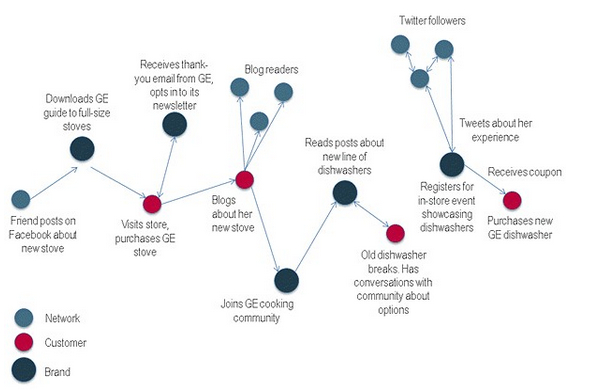
Conversely, we may also begin to understand who our customers influence, and why a successful sale might not only allow us to recognize revenue from that single purchase, but also a chain of purchases based on the influence and recommendation of our customer’s purchase decision.

These insights are not only valuable for each individual prospect or customer, but also in aggregate. By profiling groups or segments of our customer base (or our target market in general), we can potentially gain key insights into who is likely deriving the most value from our products and service offerings.

The internet is compiling a huge amount of data

Feed.ly knows that 65% of my facebook friends are male, their most popular music group is U2, and their most popular movie is Gladiator.

While this may not present immediate opportunity in your mind, the point is illustrated. By knowing who I talk to, what their interests are, when and how we communicate, there are numerous opportunities to know more about me, what my preferences are, and what opportunities exist to help me in my daily life.

IBM recently did a social network analysis project called SNAzzy , to accurately chart and predict lifetime customer value and churn rates in the telecommunications industry.

James Koblieus points out on his blog the huge impact social network analysis will have on data warehouse growth and there are plenty of other challenges that await us as we begin to analyze and make sense of this data, and integrate with our existing systems and processes.

This is a new area for me and something I’ll definitely be spending more time on. If you know of any additional resources, please send them over.

Your customers and prospects are sharing, talking, conversing, and transacting. Get to know them. Partner with them, and find more people like them.

My contribution to the #MonTwit experiment: What I've discovered about Twitter

My Introduction to Twitter

I first heard of Twitter back in early to mid 2007. Here’s what it looked like then.

I looked at the homepage and studied it curiously. “What am I doing? I thought to myself…well, surfing the internet. I’m not sure what value sharing that adds to anyone. And who’s looking at this by the way? I’ve got a family I need to protect.”

I concluded: “Nope. No value here. Maybe I’ll check it out again in a few months.”

I had maybe 2 or 3 similar experiences over the next 6 months. I was intrigued, but still felt that I had better things to do. Quite frankly, at the time, it seemed like the domain of dorks and geeks to me. Shel Israel provides fascinating history and anecdotes about the early days of Twitter in his book “Twitterville”

Roped In

I finally gave in and signed up for an account in late 2007. I found a few of my existing friends and followed them. Most of their tweet streams looked like mine. “Trying this thing out…just got home from work…”, things of that nature. I was beginning to see the value potential, though. There just wasn’t quite critical mass there yet, or so I thought. I just hadn’t learned to listen yet.

By that time, guys like Jeremiah Owyang had already figured Twitter out. By November 2007, he had already created his version of this post.

Fast forward to 2008, and I finally had made my first tweet. How’s that for impressive and engaging?

The lightbulb moment

In late 2008, I took a short drive up to Sunset Blvd. in Hollywood. Carrie Underwood, Daughtry, their managers, and the kind folks at 19 Entertainment (creators of American Idol) had graciously donated some auction items to International Princess Project for a fall event we had had. I was dropping off some Punjammies and a personal thank you note. A BIG SHOUT OUT to @adamecourt for making that happen!

(By the way, if you need some last minute Christmas presents and/or want to support a great cause making a huge difference in the lives of some of the most marginalized people on the planet, visit http://www.punjammies.com).

Down the street, also on legendary Sunset Blvd, longtime friend of mine, Elliot Loh, was leading a team of developers at Geni.com and that same group had also created what would become Yammer. He explained to me why they created it and how it benefited them. Knowing what everyone inside their walls were working on helped them to work more collaboratively as a team. It made sense. I don’t remember the quote, but he said something like this: “It’s kind of like watching TV. It’s on in the background, so I know what everyone is working on. If I have something to add or if I need some help, I’ll interject.”

Something clicked at that point for me. I began spending a little more time on Twitter, mostly listening. Separately, I began seriously considering the impact that Social Media would have on business. Specifically, I saw it having direct implications on one of my personal areas of interest and expertise: CRM – Customer Relationship Management. I saw a collision course coming, but didn’t quite know how it would play out.

The Accidental Community is formed

I turned to Twitter (and other sources), and found a small group of like minded individuals from around the globe exploring the same thoughts and ideas. A hashtag had been created by early Social CRM pioneer, Brent Leary. A guy named Prem Kumar Aparanji seemed to never sleep, relentlessly stoking the #scrm fire. An accidental community was formed. An incomplete and growing list of some of these great folks can be found here.

2009 has been a fun ride.

Here are a few things that I’ve discovered about Twitter along the way:

Twitter is the world’s greatest networking environment
I’ve “met” an incredible amount of people through Twitter. Many of these interactions have transitioned to other channels of communication: phone, email, face to face.

Without Twitter, I likely only would have met these people by chance. Twitter gave me the chance to listen to the whole world at one time, filtering global chatter by keywords I was interested in. It is never closed, and anyone can come and go as they please.

Twitter is the world’s best learning environment
If you want to learn, there is no better place. There are people offering valuable information on an infinite amount of topics. Yes, you have to learn how to filter, but once you do, there is a ton out there. The difference between just learning on the web as we have known it previously is that now in many cases, you have direct and immediate access to the creators of the content you learned from. Which leads me into my next point;

- Twitter is a “people sampler”
You can learn a little bit about a lot of people. You can see how they interact. This means that you get a small glimpse of a person through their Twitter interactions. Some you’ll desire to engage with more. Some you’ll pass on. This can be both good and bad.

- Can negatively affect your mature relationships
The ironic thing is that too much time spent on Twitter can negatively affect your mature, existing relationships. The more time one spends on Twitter is time not spent face to face with someone else. Has Twitter helped my marriage? Likely not. Be warned and be wise.

- Can become addicting if you don’t guard your time
The allure of the first two points are pretty attractive for those who are out to conquer the world. The world has never been so accessible. Many of my Twitter friends speak about increased levels of ADD, regretfully pushing high priority items to the back burner, and having to pull themselves away to “go get real work done”. Of course I never struggle with any of these things. (I’m just writing this while my task list is a mile long and Christmas is a few days away).

“Yes, honey, just a couple more minutes…” Sorry friends, but with that, I’ve got to go.

Six (wait, Seven) Questions Every Company Should be asking themselves now related to Social Media

Guido Oswald, in his blog post, Are Facebook and Twitter just new channels? makes the assertion that Facebook and Twitter might revolutionize CRM as we know it.

I would argue that Social Networks are primarily another lead generation source, and is rapidly becoming THE MEDIUM by which customers prefer to use.

The fundamentals have been around for a long time. Customers want to have a conversation about what is important to them and will align themselves with individuals and companies that best meet their needs with a valuable solution. The technology has enabled this to happen as never before.

The statistics are staggering. The next chasm to cross is how to transition those social media conversations into the transactional based CRM (which by the way is important, too), and at what point?

Either way, the questions below are pertinent for all companies to ask themselves. I would add the the list – “How Can I get my customer base talking to each other, and then listen, learn, and/or engage or intercede at appropriate times?”

Adapting to the new consumer behavioral patterns leads us to what I call a CRM 2.0 strategy any other term will do as well as long as it has the same meaning and results.

New questions must be asked:

1. How can I have a meaningful conversation with my customers?

2. How can I engage customers to take an active part in this conversation?

3. How can I leverage the knowledge and willingness of customers?

4. Does my corporate culture allow meaningful conversations what changes are required?

5. Do I know the little aches and pains of my customers? Are they dealt with?

6. Who are my customers and where / whom do the talk about products and services?

Speed, Trust, and the ROI of Relationships

A great article on leveraging the internet and social networking tools to meet and collaborate with those with whom you have a natural synergy.

Our strengths, our networks, our skill sets are complimentary. As we talked we found that we’re both saturation learners. We don’t just take on a subject. If we’re going to do something, we learn it to our fingers.

We talked about how if you land on my blog and you don’t like me, you click away in seconds and I never know. It’s efficient. No hurt feelings. No social burden; no time wasted talking to me. If you stay, we’re self-sorted. If I live up to what you expect, we’ve got a relationship. If I’m consistent and helpful, I become a trusted source.

via Guest Blogger Liz Strauss: Speed, Trust, and the ROI of Relationships – Think customers: The 1to1 Blog – Mozilla Firefox.

CNN Shows the Power of Facebook

CNN Shows the Power of Facebook

Anyone who watched CNN’s coverage of the President’s speech to Congress last night witnessed something that I believe companies will more readily leverage in 2009: the power of Facebook.

For days leading up to the speech, CNN featured an area on its site asking visitors to join CNN.com Live to have the ability to update their own Facebook status directly from the CNN.com Live player during the presidential address. As a result, users could also see status updates from their friends and other Facebook users on CNN.com Live. On Facebook, the status updates for those using CNN.com Live were published in their news feed with hyperlinked tags that read “via CNN.com Live” so users’ friends on Facebook could click the tag and join the CNN.com Live/Facebook experience.

via CNN Shows the Power of Facebook – Think customers: The 1to1 Blog – Mozilla Firefox.